An in-depth analysis of e-commerce platform performance across key verticals: Clothing, Home & Living, Beauty & Wellness, Food & Beverages, and Arts & Entertainment.
Section I. Cross-vertical macro insights
Site count: pronounced divergence
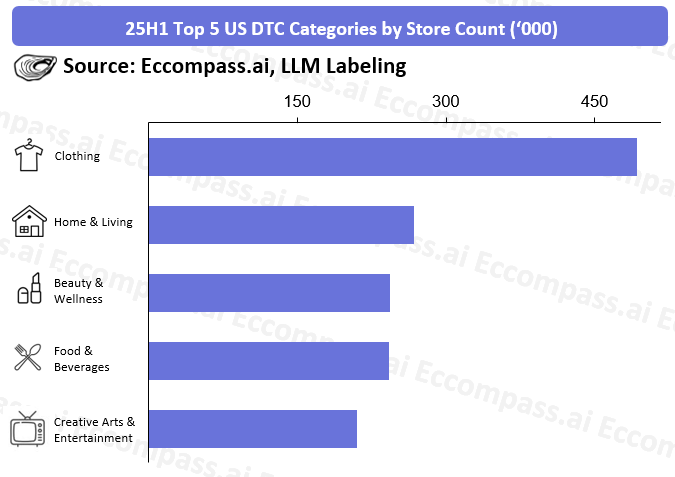
- Clothing is the largest (~493K sites). Home & Living, Beauty, and Food follow with comparable scale (~240K each), while Arts & Entertainment is the smallest (~211K).
- Notably, Arts & Entertainment is growing faster despite its smaller base, driven by accelerating digitization of ticketing, the rise of membership economies, and the shift of events (live streams/merch) to online—pulling new sites into the ecosystem and increasing online GMV penetration.
Platform concentration (approximate GMV share of the top two platforms)
- Clothing: Shopify + Custom ≈ 71% (highly concentrated; mature DTC brand penetration)
- Home & Living: Shopify + Custom ≈ 59% (mid-to-high concentration; balances content needs with complex configuration)
- Beauty & Wellness: Shopify + Custom ≈ 67% (highly concentrated; strong brand equity and subscription-driven repeat)
- Food & Beverages: Shopify + Custom ≈ 45% (most fragmented; O2O dynamics and vertical restaurant SaaS on the rise)
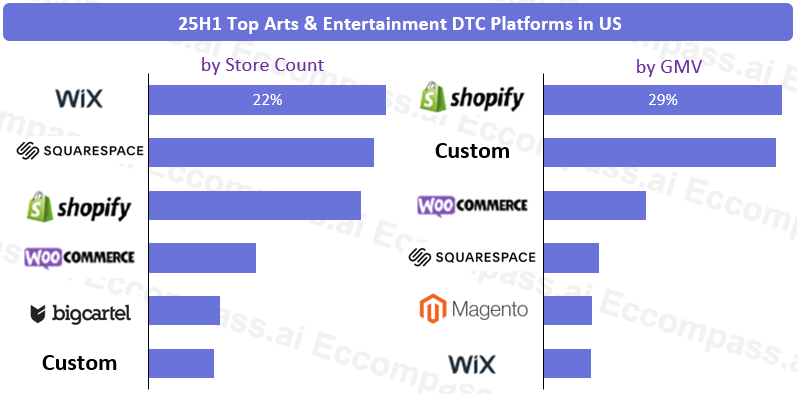
- Arts & Entertainment: Shopify + Custom ≈ 57% (customization-heavy; complex flows like ticketing/membership)
Takeaway
- Clothing and Beauty are the most “platformed + brand-driven”.
- Food is the most “ecosystem-diverse”.
- Arts & Entertainment is pulled by ticketing and membership use cases into a “custom-augmented + platform-parallel” dual-track structure.
Section II. Platform share–positioning
Shopify
- Cross-vertical GMV leader: Clothing 51%, Beauty 55%, Home 37%, A&E 29%, Food 23%.
- Most verticals show a “site > GMV” gap due to its all-segments strategy pulling in long-tail and mid-market merchants, lowering GMV/site.
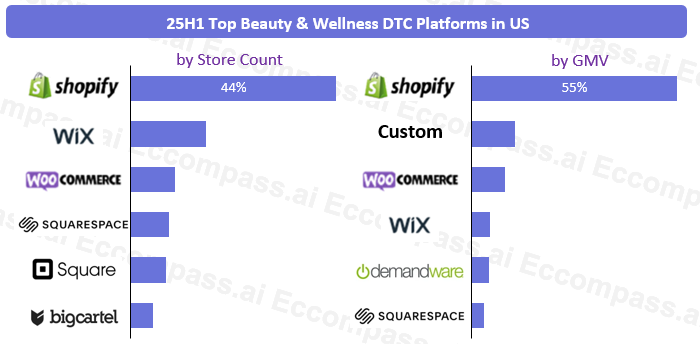
- Beauty is the exception: 44% of sites deliver 55% of GMV (positive over-indexing via subscriptions and repeat).
Custom
- “Few sites, high GMV” profile: Clothing 20%, Home 22%, Food 22%, A&E 28%.
- Chosen by top brands for deep integrations, complex pricing/inventory, ticketing/membership, and global compliance.
Wix / Squarespace / BigCartel
- High by site share, low by GMV in most categories (Food is a partial exception).
- Positioned for starter/showcase/light-SKU and content-led use cases; act as the reservoir for upward migration.
WooCommerce
- Stronger in Home (12% GMV) and Food (14% GMV); weaker in Clothing (2%) and Beauty (9%).
- Fits SEO/content-led and cost-sensitive merchants; higher in-house engineering demands.
Demandware / Magento / BigCommerce
- Hold ground in Clothing and Home where complex catalogs, configurators, and OMS/ERP depth matter—GMV Top 5 despite smaller site bases.
- Less durable in Beauty, Food, A&E where needs are more scenario-specific (subscriptions/CRM; store-linked instant fulfillment; ticketing/seating/dynamic pricing).
Section III. Insights
Standardization and customization must co-exist; core transaction scenarios by vertical drive divergent tech-stack choices.
- Shopify holds an overarching lead across categories, but cannot fully cover deep, niche workflows. For example, in Arts & Entertainment, ticketing and membership complexity still pushes a sizable share toward Custom or vertical solutions. At the same time, on content-led long tail, Wix/Squarespace can surpass Shopify by site count in certain sectors.
- Enterprise suites (Demandware/Magento/BigCommerce) retain strong positions in Clothing and Home, where complex catalogs and heavy integrations matter. In more scenario-driven categories—subscriptions and replenishment (Beauty), O2O fulfillment (Food), ticketing and membership (A&E)—generalist suites need more composable and headless flexibility to avoid being displaced by Custom builds or vertical SaaS.
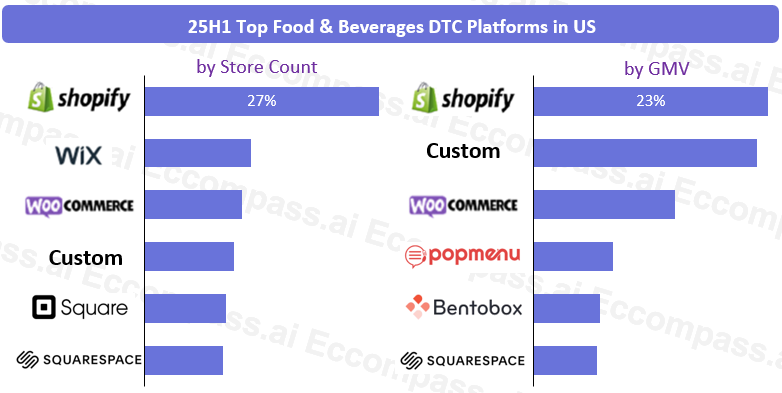
- Nontraditional ecommerce stacks are also material. In Food segment, Popmenu (8% GMV) and BentoBox (6%)—vertical restaurant SaaS—offer superior solutions for end-to-end “order–delivery–pickup” O2O flows, underscoring that localized “transaction + fulfillment” capability is the decisive advantage in this category.
Section IV. Vertical analysis
Clothing
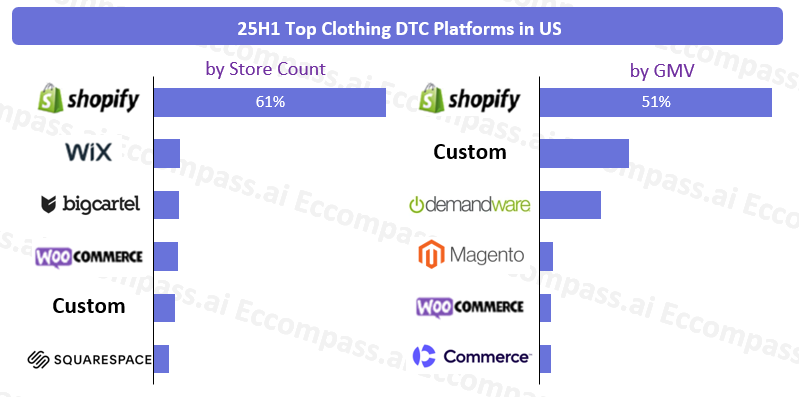
- Shopify remains the dual leader, with 51% GMV share and 61% site share. The long-tail “more stores than volume” effect is evident, with a 10pp gap—scale ≠ revenue.
- Custom and enterprise (Demandware 13%, Magento 3%; combined with Custom totals 43% GMV) capture high-value GMV with fewer sites (Custom only 5% of sites), showing strong headweight and markedly higher GMV per site.
- Wix/BigCartel/Squarespace rank high by site share (Wix 7%, BigCartel 7%, Squarespace 4%) but are absent from GMV leadership or contribute modestly—more a “site pool” than a “transaction pool.”
Home & Living
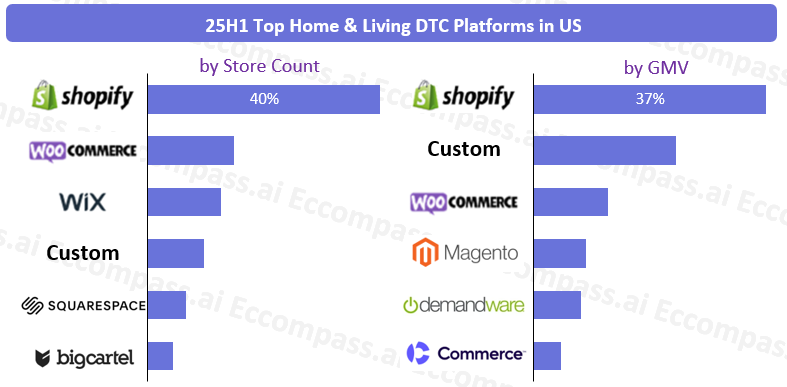
- Competition is more fragmented; Shopify’s dominance is weaker than in Clothing: 37% GMV share vs. 40% site share, a 3pp gap (vs. 10pp in Clothing), indicating a more balanced structure and lighter long-tail drag.
- WooCommerce, Magento, and Demandware are stronger: WooCommerce 12% GMV (15% of sites), Magento 8% GMV, Demandware 7% GMV—driven by complex catalogs/configurators and ERP/OMS integrations.
- Custom holds a meaningful share (22% GMV, 10% of sites), suggesting multi-supplier setups and complex fulfillment push merchants toward more flexible or self-built stacks.
Beauty & Wellness
- Shopify delivers the highest GMV per site in this vertical: 55% GMV share vs. 44% site share, a positive mismatch with GMV outpacing sites by 11pp.
- Design-centric platforms are gaining visibility: Wix + Squarespace account for 24% of sites (Wix 16%, Squarespace 8%) but only 8% of GMV (Wix 5%, Squarespace 3%), still less efficient than Shopify.
- Custom/enterprise is present but less pronounced than in Clothing: Custom 12% GMV, Demandware 5% GMV. The platform-side marketing and subscription ecosystems cover most mainstream needs effectively.
Food & Beverages
- The most fragmented platform landscape; Shopify’s scale doesn’t fully convert to GMV: 23% GMV share vs. 27% site share, a 4pp gap—GMV per site is constrained by offline reliance and instant fulfillment needs.
- Vertical restaurant SaaS is strong: Popmenu 8% GMV, BentoBox 6% GMV; Squarespace also at 6% GMV—natively aligned with menus, time slots, pickup, and delivery.
- Custom and WooCommerce remain meaningful: Custom 22% GMV, WooCommerce 14% GMV—scenario specificity and local execution are the decisive factors.
Arts & Entertainment
- Wix/Squarespace lead on site share: a combined 43% (Wix 22%, Squarespace 21%), but together contribute only ~13% of GMV—low transaction efficiency and the strongest mismatch.
- GMV is led by Shopify and Custom: Shopify at 29% GMV is just 1pp above Custom at 28%, indicating a dual-polar structure. Shopify excels at standardized transactions but has limited reach among non-commercial users.
- Platform choice bifurcates: visibility/content-led use cases (Wix/Squarespace: high sites, low GMV) vs. high-complexity transactions (Shopify/Custom: high GMV), creating a pronounced divergence between site counts and GMV.